
Dying Without a Will
When a person dies without a Will, it is referred to as dying 'intestate'.
If this happens, an eligible person can make an application to the ACT Supreme Court for Letters of Administration. This document is the court’s formal approval for an appointed person, known as the administrator, to administer the deceased person’s estate.
Typically, the administrator is a person with an interest in the estate (e.g. spouse or children) and is chosen by the court having jurisdiction over the person's property.
The identification of the eligible beneficiaries to the estate and distribution of the property of a person who dies intestate is the responsibility of the administrator of the estate.
Who is entitled in an intestate estate?
If you die without a Will, your estate is distributed according to the laws of intestacy. The below flowchart illustrates these laws:
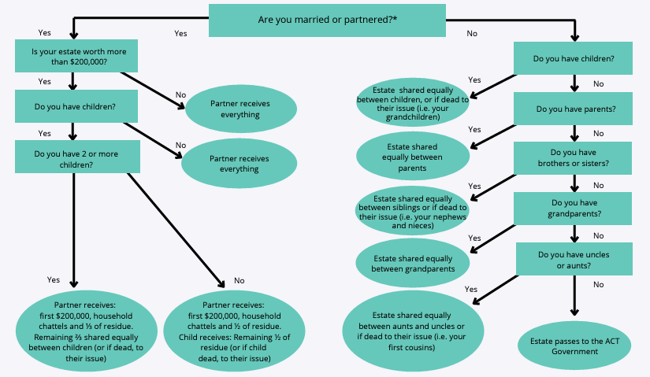
* Partner means: your husband/wife/civil partner, or your domestic partner if:
- they have been your partner continuously for 2 years or more, or
- they are the parent of your child
Does the PTG administer intestate estates?
The PTG may elect to administer an intestate estate where there is an estate to administer and it is determined that there is no one else to administer.
The PTG is not required by law to administer any estate and will assess each request to administer on an individual basis.
Fees apply to the PTG’s administration of deceased estates and can be found here: https://www.ptg.act.gov.au/our-fees.
For general Estates related enquiries please contact us via PTG_WETU@act.gov.au.